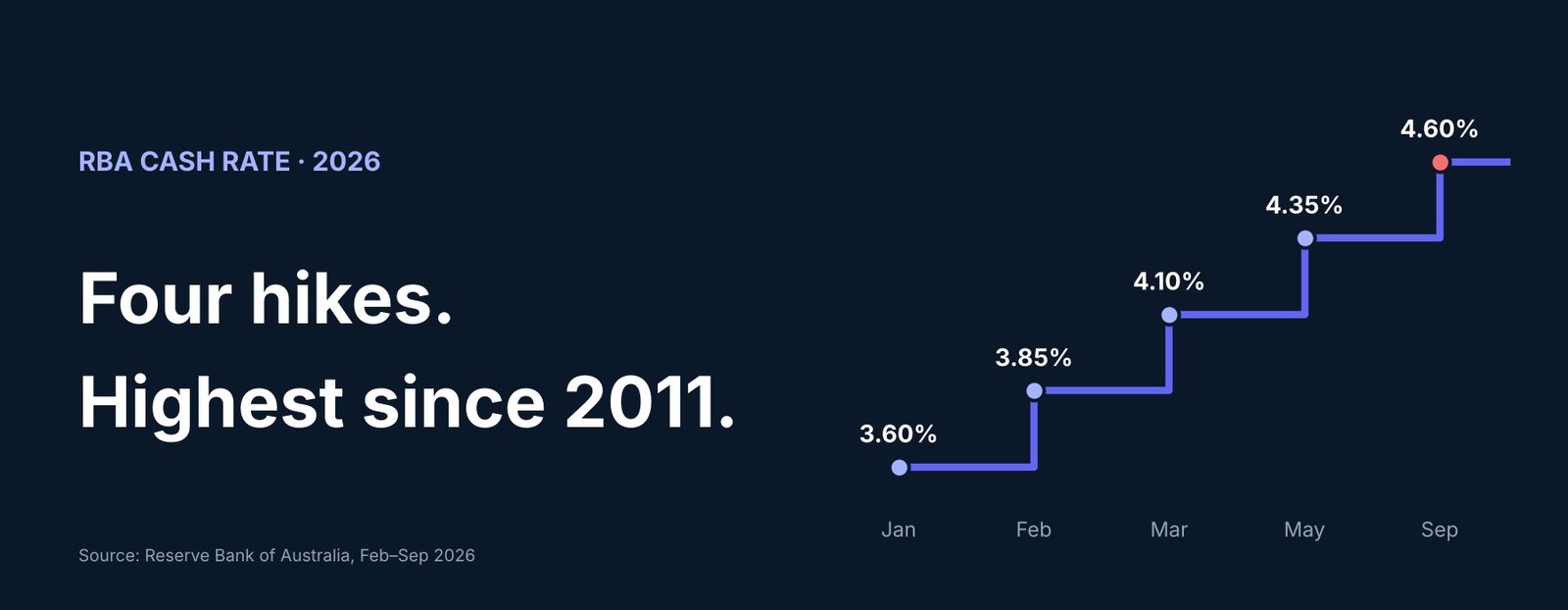
On 29 September, the Reserve Bank lifted the cash rate by another 0.25 percentage points to 4.60% — its fourth increase this year and the highest level since late 2011. Since January the cash rate has climbed a full percentage point. At the same time, property values have now fallen for six months in a row, and new negative gearing and capital gains tax rules are on the way. If you own an investment property with a loan, all three of these hit the same set of numbers: yours. Here's what has changed, what it costs, and what you can actually do about it.
What happened, and why
The RBA has raised rates in February, March, May and now September, taking the cash rate from 3.60% to 4.60%. The board's decision was unanimous. Its reasoning is simple: inflation is still too high. Annual inflation was running at around 3.5–3.6% in July, above the bank's 2–3% target band.
The board pointed to several pressures pushing prices up:
- Energy prices. Global energy costs remain elevated, driven partly by conflict in the Middle East.
- Business costs. Australian firms are facing higher costs and are raising, or planning to raise, their prices.
- Technology prices. Strong global demand linked to AI is pushing up the cost of technology.
The RBA said it will keep doing what it considers necessary to get inflation back to target — including raising rates again if needed. The next decision is on 3 November. ANZ and BetaShares are both tipping another 0.25 point rise to 4.85%, depending on the September-quarter inflation figures due on 28 October. CBA's economists don't expect any relief until rate cuts in the second half of 2027.
What it costs you
For a standard principal-and-interest loan, here's what Canstar calculates the September hike alone adds to monthly repayments — and what all four 2026 hikes add together, assuming your lender has passed every one on in full:
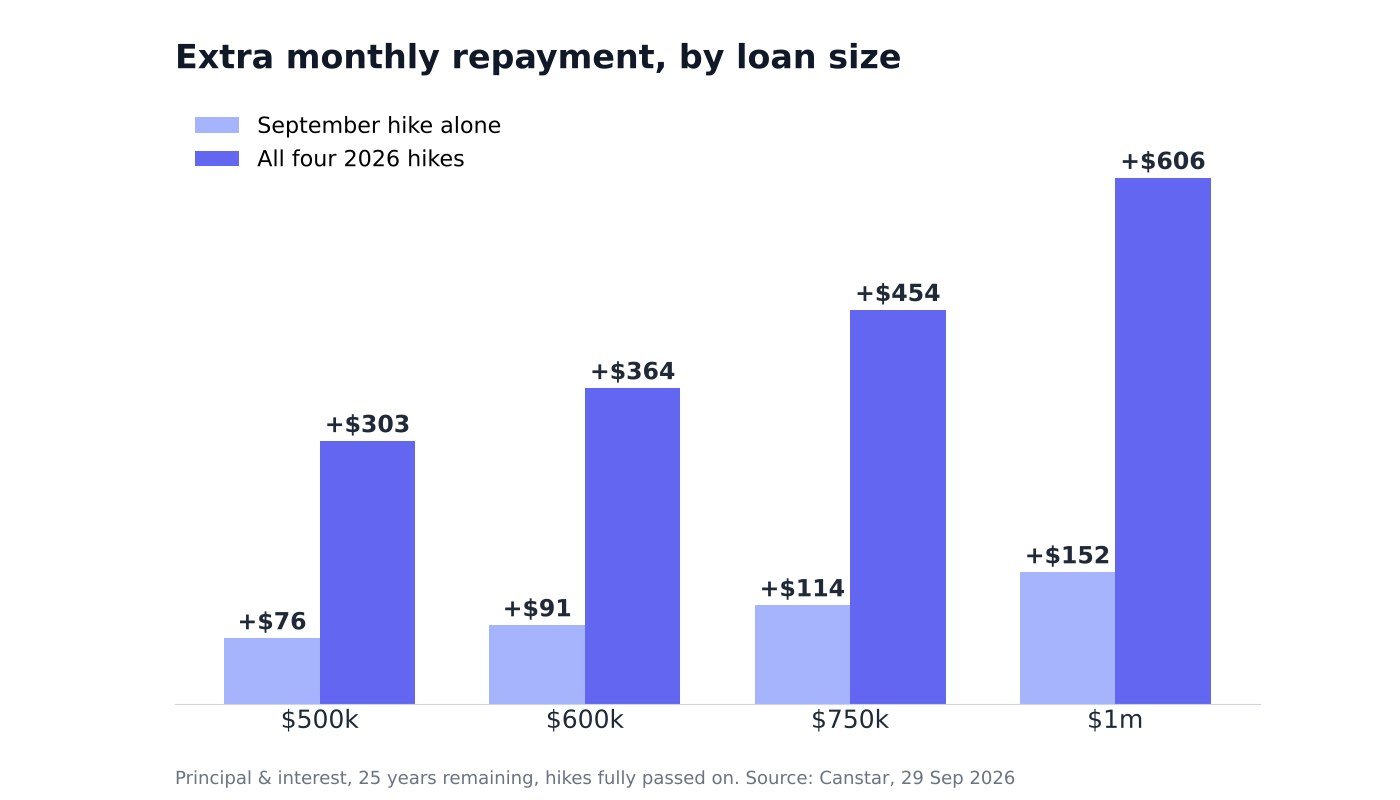
On a $750,000 loan, this year's four hikes add around $454 a month — over $5,400 a year.
Many investors are on interest-only loans, where the hit is even easier to see. On a $600,000 interest-only loan, a one percentage point rise means roughly $6,000 a year in extra interest — about $500 a month more than in January. Interest on an investment loan is generally tax deductible, so the real after-tax cost is lower, but how much lower depends on your own tax rate. Either way, it's money that has to come from somewhere every month.
Prices are falling — almost everywhere
Higher rates mean buyers can borrow less. Since the start of the year, borrowing capacity for a single person has dropped by around $47,000, and by about $94,000 for a couple. That shows up in prices:
- National values fell 1.1% in September, the sixth monthly fall in a row, and are now 5.2% below their March peak.
- Sydney and Melbourne are down 7.0% and 6.2% over the past year.
- 97% of capital city suburbs recorded a fall over the three months to September.
- Homes are taking longer to sell — a median of 39 days, up from 23 a year ago — and sales volumes are down about 19% nationally.
Perth is the exception, but it's turning. Perth values are still up 10.1% over the year, with a median of around $975,000. But they dropped 1.2% in September alone and about 4.7% over the quarter. If you bought in Perth recently, the strong annual number may hide the fact that the market has already started to slip.
Cotality's research director noted that households now carry much more debt than they did 15 years ago, which makes them more sensitive to every rate rise — and that the RBA's move will weigh on housing demand.
Rents are rising — but not fast enough to close the gap
The good news for landlords: national rents are still up about 5.5% over the year. In Perth, the vacancy rate sits at around 2.1%, which means good properties are still renting quickly.
The harder truth is the maths. Perth's average gross rental yield is about 4.0%, and nationally it's around 3.85%. The cheapest variable home loan rates on the market are now above 5.6% — and investor loans usually cost more than that. For most investors with a sizeable loan, the rent no longer covers the interest, let alone rates, insurance, maintenance and fees. Rent increases also can't simply follow every rate hike: in WA, rent can only be increased once every 12 months.
The tax clock is ticking too
Rate rises aren't the only thing changing the numbers. Negative gearing and capital gains tax changes announced in the May budget passed Parliament on 25 June 2026 and take effect on 1 July 2027.
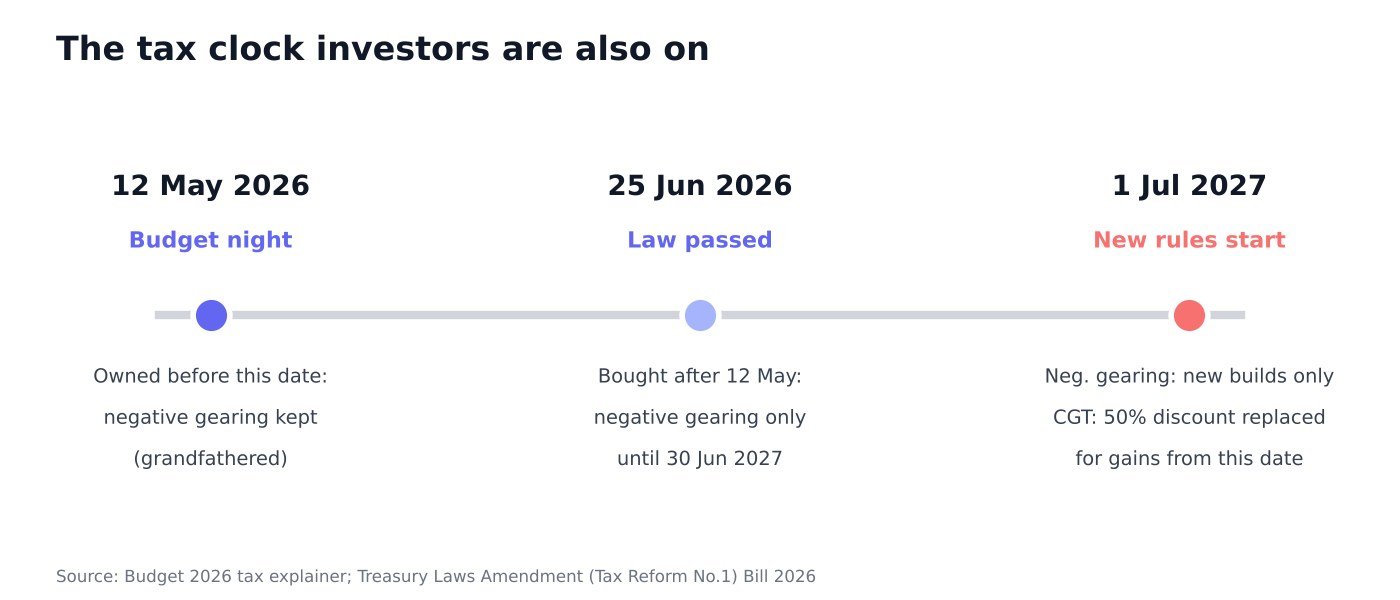
Which rules apply to you depends on when you bought.
- Bought before 12 May 2026? You keep negative gearing on that property — your existing arrangement is grandfathered.
- Bought an established property after 12 May 2026? You can negatively gear it only until 30 June 2027. After that, losses can only be offset against other residential property income, not your wages.
- Buying a new build? New builds that add to housing supply keep negative gearing.
- Capital gains tax. For gains made from 1 July 2027, the 50% discount is replaced by indexation (adjusting your cost for inflation) plus a 30% minimum tax on the gain. Gains made before that date still get the 50% discount.
Cotality reports that these changes have already caused a sharp drop in investor demand. Fewer investors buying means less competition if you're looking, but also fewer buyers if you're selling.
What you can actually do
- Run your numbers again. Compare your monthly repayment today with January's. Add up rent coming in versus every cost going out — interest, rates, strata, insurance, maintenance, fees. Know your real monthly shortfall.
- Call your lender, or shop around. Lenders compete hard for borrowers. Asking for a better rate, or comparing a refinance, is often the fastest saving available.
- Build a buffer now. Markets are tipping another rise in November. Plan for at least one more increase rather than hoping for a pause.
- Price rent to the market at your next review. Check comparable listings before your annual increase. A fair rent keeps a good tenant; an empty property costs far more than a modest rent rise brings in.
- Don't panic-sell into a falling market. With homes taking longer to sell and buyers borrowing less, a rushed sale is usually a discounted sale. Get advice before making a big decision.
- Cut the costs you control. You can't change the cash rate, but you can change what you pay to manage the property. Agent fees of several thousand dollars a year come straight out of the same cash flow that interest rates are squeezing — which is exactly the gap self-managing closes.
Bottom line
Your investment property isn't necessarily a bad investment because rates went up — but the numbers that made sense in January have changed, and they could change again in November. The investors who come through this well are the ones who know their real monthly position, keep their costs tight, and don't make big decisions in a hurry.